
10 Aug Why Every Real Estate Agent Needs a Local SEO Strategy in 2026 (And How to Build One)
The way people find real estate agents has changed completely. Most buyers and sellers no longer ask a neighbor for a recommendation first. They open Google. They type something like “real estate agent near me” or “homes for sale in Austin.” What comes up in those first few results decides who gets the call.
That is why a local SEO strategy is no longer optional for real estate professionals. It is the foundation of how agents get discovered, how they build trust before the first conversation, and how they stay competitive in markets that grow more crowded every year. This guide explains why 2026 demands action and walks through exactly how to build a strategy that works.
The Numbers That Make the Case
The data behind local search in real estate is striking. According to recent industry research, 93% of homebuyers use local search to find properties. Additionally, searches for “real estate agent near me” have grown 41-fold since 2015 and now generate approximately 14,000 monthly searches. SEO accounts for 53% of all website traffic for real estate agents, leading many firms to partner with a specialized link building service provider in real estate—especially as 54% of real estate professionals say SEO is their most effective marketing channel.
Local search drives over 70% of leads for real estate agents. Yet many agents still rely primarily on referrals, print advertising, or paid social media. Those channels have value, but they do not capture a buyer who searches at 11 pm from their couch. Organic local search does.
Furthermore, agents who invest in SEO generate leads at 61% lower cost than those who rely exclusively on paid advertising. The long-term return is compelling. A well-optimized local presence keeps generating leads long after the initial work is done.
Why 2026 Is a Turning Point for Local Search
Search behavior is evolving faster than most agents realize, leading to the classic scenario of a real estate website losing buyers. Google’s AI Overviews now appear in search results for a wide range of queries. AI tools like ChatGPT and Perplexity are also becoming part of how buyers research neighborhoods, schools, and market trends.
However, one important fact works in agents’ favor. AI-triggered results currently appear in only 5.8% of real estate-related searches — one of the lowest rates of any major consumer category. That means agents who optimize their local presence now face far less competition for AI citations than professionals in almost any other local services field.
Additionally, Google’s Gemini AI models now draw directly from Google Business Profile data to answer local queries. Therefore, an optimized profile does not just help you appear in traditional search results. It also positions you to appear in AI-generated answers that an increasing number of buyers will see first.
The window to act ahead of competitors is open. It will not stay open forever.
What a Local SEO Strategy Actually Covers
A local SEO strategy is not a single tactic. It is a connected system of actions that work together to establish your authority in a specific geographic area. The core components are as follows.
| Component | What It Does |
| Google Business Profile | Places you in map results and local packs |
| NAP Consistency | Builds trust signals across directories and platforms |
| Neighborhood Content | Ranks you for area-specific search terms |
| Online Reviews | Builds credibility and influences ranking |
| Local Backlinks | Establishes authority with Google in your area |
| Mobile Optimization | Captures the 89% of searches that happen on mobile |
Each of these components supports the others. A strong Google Business Profile with poor NAP consistency still loses ground. Good content with no reviews lacks the trust signals Google needs. The strategy only works when all parts move together.
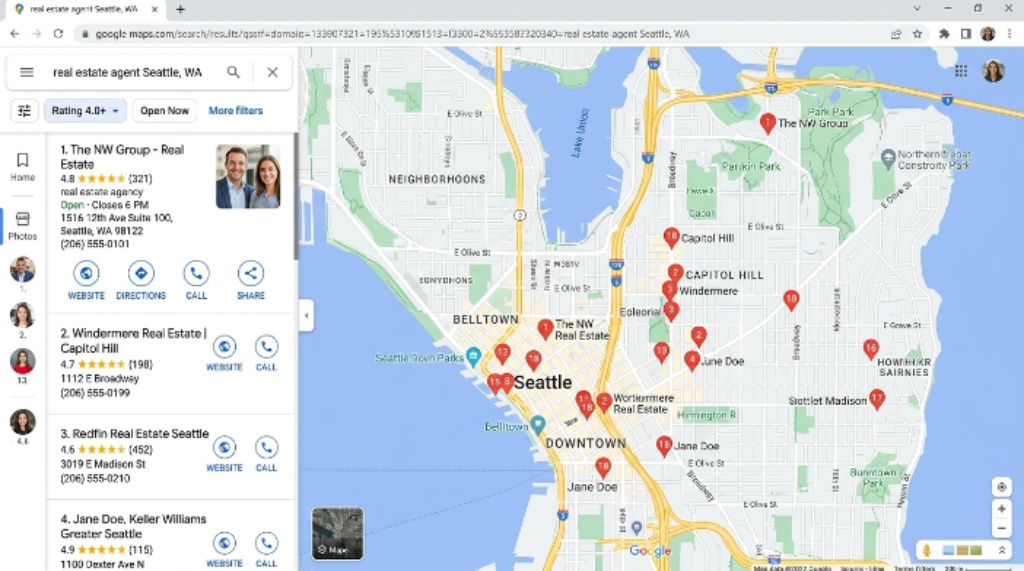
Step One: Claim and Fully Optimize Your Google Business Profile
Your Google Business Profile is the most powerful single asset in your local SEO toolkit. It drives 33% of all local clicks and is the top local SEO ranking factor for real estate. Google ranks local results based on three factors: relevance, distance, and prominence. Your profile directly influences all three.
Start by claiming your profile at business.google.com if you have not already. Then complete every single field. Incomplete profiles rank lower. Google rewards thoroughness.
Here is what to prioritize when building out your profile:
- Choose “Real Estate Agent” as your primary category. Avoid generic categories like “Business Consultant.”
- Write a specific business description that names the areas you serve, the type of clients you help, and what makes you different from other agents in the market.
- Add ten to fifteen high-quality photos. Use real images of yourself, your listings, and local landmarks. Real faces outperform stock images consistently.
- List every service you offer, including buyer representation, seller consultation, relocation services, and investment property guidance.
- Post updates at least once per week. Share new listings, buyer tips, or local market data. Google rewards profiles that stay active.
One critical detail that many agents overlook is NAP consistency. NAP stands for Name, Address, and Phone Number. These three pieces of information must be identical everywhere your business appears online — your website, your Google Business Profile, Zillow, Realtor.com, your brokerage’s website, and every social media platform. Even a small difference, such as “Street” on one platform and “St.” on another, sends conflicting signals to Google and reduces your local ranking. Think of it as your digital fingerprint. If the fingerprints do not match across the web, Google does not trust the listing enough to rank it prominently.
Step Two: Build Neighborhood Pages That Rank for Local Searches
Google rewards agents who demonstrate deep knowledge of specific geographic areas. One of the most effective ways to do this is by creating comprehensive neighborhood pages on your website.
A neighborhood page is not a simple list of current listings. It is a detailed guide that covers everything a buyer or seller would want to know about living in that area. Each page should cover the overall character of the neighborhood, typical home styles and price ranges, nearby schools and ratings, local amenities, commute options, and current market trends.
These pages work because they target high-intent search terms like “homes for sale in Lincoln Park” or “real estate agent in Midtown Atlanta.” Buyers searching these terms are not browsing casually. They have already narrowed down where they want to live. Showing up in those results puts you in front of serious prospects at exactly the right moment.
Additionally, publishing detailed neighborhood content builds what Google calls topical authority. One neighborhood page has limited impact. However, twenty well-written neighborhood guides covering your entire market signals to Google that you are a genuine local expert. That recognition compounds over time and raises your visibility across a wider range of related searches.
Aim for pages of at least 1,000 words per neighborhood. Update them quarterly to keep information current, particularly market data and school ratings.
Step Three: Generate and Respond to Online Reviews
Reviews are among the most influential factors in local search rankings. They also directly affect whether a potential client chooses to contact you. A profile with dozens of recent, positive reviews consistently outperforms one with few or outdated reviews, even when other factors are equal.
The most effective way to get reviews is simply to ask. After a successful closing, reach out to your client directly and explain how much a review would help your business. Most satisfied clients are happy to help. However, the timing matters. Ask within a day or two of closing while the experience is still fresh.
When you receive a review, respond to it. Thank the reviewer by name. Reference something specific from the transaction. This signals to Google that your profile is actively managed. It also shows potential clients that you are engaged and attentive.
Do not ignore negative reviews. A thoughtful, professional response to a negative review often does more for your reputation than ten glowing ones. It shows that you take feedback seriously and handle difficult situations with maturity.
Step Four: Create Content That Answers Local Questions
Search engines increasingly reward content that answers specific questions buyers and sellers have at each stage of their journey. Therefore, your website should include a regular blog or resource section that addresses the questions your target clients actually search for.
Good content topics for real estate agents include local market reports published monthly, guides for first-time homebuyers in your city, neighborhood comparison articles, school district overviews, and answers to common questions about the buying or selling process in your state.
FAQ-style content is particularly effective in 2026 because it captures voice search queries and the question-based searches that are increasingly common on mobile devices. When someone asks their phone “What are the best neighborhoods for families in Denver?” your FAQ page can be the answer Google surfaces.
Additionally, long-tail keywords drive 70% of real estate search traffic. These are longer, more specific search phrases that reflect genuine buyer intent. Targeting them through blog content and neighborhood guides puts you in front of a smaller but far more motivated audience than broad terms ever could.
Step Five: Build Local Backlinks and Community Presence
A backlink is a link from another website to yours. Google treats backlinks as votes of confidence. Local backlinks — links from websites in your geographic market — carry particular weight for local search rankings.
Real estate agents can earn local backlinks by contributing guest articles to local news outlets, sponsoring community events and getting listed on event websites, partnering with local businesses like mortgage brokers and home inspectors, joining the local chamber of commerce, and participating in neighborhood associations that maintain online directories.
These activities build digital authority and reinforce your standing as a genuine local presence. Over time, they contribute meaningfully to how prominently Google ranks your profile and website in local results.
Common Mistakes to Avoid
Many agents put in effort but undermine their results with a few recurring errors.
- Using a P.O. box instead of a physical address on their Google Business Profile
- Letting their profile go weeks without a new post or photo
- Never responding to reviews, either positive or negative
- Writing generic business descriptions that could apply to any agent anywhere
- Having inconsistent NAP information across platforms
- Neglecting mobile page speed, despite 89% of real estate searches happening on mobile devices
Each of these mistakes costs visibility. Fixing them costs nothing but time.
Conclusion
Local search is how most buyers and sellers find their real estate agent in 2026. A well-built local SEO strategy puts you in front of the right people at the exact moment they are ready to act. It starts with a fully optimized Google Business Profile, extends through neighborhood content and consistent NAP information, and grows through reviews, local backlinks, and regularly published local content. The agents who invest in this foundation now will dominate their local search results for years. Those who wait will find themselves invisible to a growing share of the market. The strategy is clear. The opportunity is real. The time to build it is now.
Frequently Asked Questions
What is local SEO and why does it matter for real estate agents?
Local SEO is the process of optimizing your online presence so that you appear prominently in geographically relevant search results. It matters for real estate agents because over 93% of homebuyers use local search to find properties and professionals. Without a local SEO strategy, you are invisible to a large portion of your potential market.
How long does it take to see results from local SEO?
Most agents see early improvements in their Google Business Profile rankings within four to eight weeks of completing a full optimization. Review generation tends to have the fastest impact, with a consistent flow of new reviews shifting local rankings within two to three weeks. Neighborhood content and backlink building take longer to compound but produce sustained, long-term gains.
Do I need a website to rank in local search results?
A well-optimized Google Business Profile can generate visibility on its own. However, a website significantly strengthens your overall local SEO performance. Neighborhood pages, blog content, and FAQ sections on your website help you rank for a wider range of local search terms and build the topical authority that Google rewards over time.
How important are online reviews for local SEO?
Reviews are among the most important ranking factors in local search. They influence both where your profile ranks and whether potential clients choose to contact you. Agents with a steady stream of recent, positive reviews consistently outrank competitors with outdated or sparse review profiles. Always ask satisfied clients for a review shortly after closing.
What is NAP consistency and why does it affect rankings?
NAP stands for Name, Address, and Phone Number. Google cross-references this information across dozens of online platforms and directories. If your business details differ between your website, Google Business Profile, Zillow, and social media pages, Google loses confidence in the accuracy of your listing and ranks it lower. Keeping your NAP identical across all platforms is one of the easiest and most impactful fixes any agent can make.
No Comments